
2021 Audi A4 Avant: Touring Features Analysis

- 2021 Audi A4 Avant: Touring Features Analysis
- What’s New and Model Updates in the 2021 Audi A4 Avant
- 2021 Audi A4 Avant – Key Model Updates Overview
- Exterior Design Revisions and Lighting Updates
- Powertrain and Mild-Hybrid Efficiency Enhancements
- Platform Rigidity, NVH Improvements and Structural Additions
- Digital Cockpit Hardware Upgrades and Software Evolution
- Suspension Calibration Updates and Touring Stability Improvements
- Engine Options and Performance Characteristics of the 2021 Audi A4 Avant
- 2021 A4 Avant Engine Specification Overview
- TFSI Combustion Strategy and Turbo Response Behaviour
- Mild-Hybrid System Functionality in Daily Operation
- S tronic Transmission Logic and Gear Ratio Distribution
- Power Delivery Behaviour Summary
- Real-World Acceleration, In-Gear Pull and Elasticity
- Thermal Management, Cooling Circuit Design and Heat Control
- Drive Select Power Delivery Differences Across Modes
- Driving Experience and Handling Behaviour of the 2021 Audi A4 Avant
- Steering Calibration, On-Center Stability and Feedback
- Suspension Behaviour Across Mixed Road Surfaces
- Dynamic Handling Characteristics Overview
- quattro Torque Distribution Logic and Grip Consistency
- High-Speed Aerodynamic Stability and Body Control
- Brake Pedal Feel, Heat Resistance and Repeated-Stop Performance
- Interior Design, Material Quality and Comfort of the 2021 Audi A4 Avant
- Driver-Focused Ergonomics and Cabin Geometry
- Seating Structure, Cushion Density and Long-Distance Support
- Noise Isolation, Cabin Acoustics and NVH Mitigation
- Comfort-Oriented Interior Features
- Climate Control Performance and Environmental Comfort
- Safety and Driver Assistance Systems in the 2021 Audi A4 Avant
- Sensor Suite Architecture and Hardware Processing Power
- Assistance System Hardware Overview
- Adaptive Cruise Control Behaviour and Lane Guidance Quality
- Collision Mitigation, Emergency Braking and Threat Prediction
- Low-Speed Manoeuvring and Parking Assistance Logic
- Structural Crash Protection and Impact Energy Management
- Technology, Infotainment and Digital Systems of the 2021 Audi A4 Avant
- MMI Touch Interface Responsiveness and UI Flow
- Virtual Cockpit Display Logic and Graphic Fidelity
- Connectivity Functions, Smartphone Integration and eSIM Services
- Digital Function Highlights
- Audio System Engineering, DSP Logic and Sound Reproduction
- Over-the-Air Update Capability and Module Partitioning
- Fuel Efficiency and Real-World Economy of the 2021 Audi A4 Avant
- Fuel Consumption Comparison Across A4 Avant Engine Variants
- TFSI Consumption Characteristics in Urban and Touring Use
- Mild-Hybrid Recuperation Efficiency and Coasting Function
- Aerodynamic Influence on Long-Distance Fuel Economy
- Dimensions, Cargo Capacity and Practicality of the 2021 Audi A4 Avant
- Passenger Space, Seating Geometry and Cabin Packaging
- Practicality-Oriented Advantages
- Cargo Bay Volume, Floor Design and Load Flexibility
- Daily Usability, Entry/Exit Comfort and Cabin Accessibility
- Urban Maneuverability, Turning Radius and Exterior Proportions
- Common Issues, Reliability Trends and Technical Notes on the 2021 Audi A4 Avant
- Electronics Behaviour, Sensor Stability and Software Variability
- Powertrain Durability, Wear Patterns and Long-Term Health
- Common Technical Issue Overview
- Interior Fit-and-Finish Deviations and Material Behaviour
- Sensor Sensitivity in Adverse Weather and Environmental Factors
- Maintenance Requirements and Ownership Experience of the 2021 Audi A4 Avant
- Scheduled Service Items, Intervals and Required Checks
- Primary Maintenance Tasks
- Consumable Wear Characteristics and Longevity Expectations
- Parts Availability, Platform Serviceability and Repair Access
- Long-Term Operating Behaviour and Ownership Insights
- Frequently Asked Questions About 2021 Audi A4 Avant
- Is the 2021 Audi A4 Avant a reliable long-term vehicle?
- How comfortable is the A4 Avant for long-distance touring?
- Does the A4 Avant offer good fuel economy in real-world use?
- What technology features stand out in the 2021 A4 Avant?
- Are there common issues owners should be aware of?
- How does quattro improve all-weather capability?
- What maintenance steps help prolong engine life?
- Is the A4 Avant practical for family use?
The 2021 Audi A4 Avant evolves Audi’s long-established premium wagon formula with a more rigid MLB platform, refined TFSI mild-hybrid powertrains and an upgraded digital cockpit centred around Audi’s newest software architecture. Blending touring practicality with precise chassis tuning, the A4 Avant introduces redesigned LED signatures, enhanced suspension calibration, improved NVH isolation and expanded driver-assistance functionality. Its elongated body structure supports better load flexibility without compromising handling balance, making the 2021 Avant a technically advanced and versatile alternative within the midsize premium segment.
What’s New and Model Updates in the 2021 Audi A4 Avant
The 2021 Audi A4 Avant receives a comprehensive series of mechanical, digital and structural refinements designed to elevate its touring capability and overall precision. Built on the strengthened MLB platform, the model benefits from revised exterior geometry, updated TFSI mild-hybrid engines, improved chassis isolation and Audi’s next-generation digital cockpit. With sharper lighting signatures, expanded assistance-system functionality and revised suspension calibrations, the A4 Avant positions itself as a more efficient, quieter and dynamically confident premium wagon.
2021 Audi A4 Avant – Key Model Updates Overview
| Update Area | Technical Enhancement |
|---|---|
| Exterior | Sharper LED signatures, reprofiled bumpers, refined aero paths |
| Powertrain | Updated TFSI units with 12V MHEV integration |
| Electronics | Faster MMI processor, improved data-fusion unit |
| Chassis | Revised damper valving and bushing materials |
| Interior | Enhanced digital cockpit and acoustics |
Exterior Design Revisions and Lighting Updates
Audi updates the Avant’s exterior with narrower LED modules, a flatter grille and revised aero channels along the bumper edges. How do these changes influence stability at motorway speeds? The reprofiled lighting units and cleaner bumper geometry reduce frontal turbulence, improving high-speed directional stability and lowering wind noise during long touring sessions.
Powertrain and Mild-Hybrid Efficiency Enhancements
The 12-volt mild-hybrid system integrates a belt-starter generator to support low-load driving and recuperate energy. How does this hybrid support improve real-world efficiency? The system fills torque gaps during gentle throttle inputs and enables extended coasting phases, reducing fuel consumption while maintaining smooth acceleration.
Platform Rigidity, NVH Improvements and Structural Additions
Additional reinforcement points at the firewall and subframe increase torsional rigidity and reduce micro-vibrations. How does this structural improvement affect cabin comfort? The stiffer mounting points create a more stable base for the suspension, reducing vibrations transferred into the cabin and contributing to quieter long-distance cruising.
Digital Cockpit Hardware Upgrades and Software Evolution
The MMI Touch system receives a faster processor and streamlined menu architecture, while the Virtual Cockpit offers improved graphic rendering. Why does the digital interface feel more fluid during multitasking? Higher-bandwidth data channels reduce latency between system modules, allowing rapid transitions between navigation, media and vehicle settings.
Suspension Calibration Updates and Touring Stability Improvements
Revised damper valving enhances impact absorption while maintaining body control on demanding surfaces. What benefit do these updates provide during long-distance travel? The refined damping curve smooths out high-frequency bumps, reducing fatigue for passengers while keeping the wagon more settled during variable road textures.
Engine Options and Performance Characteristics of the 2021 Audi A4 Avant

The 2021 Audi A4 Avant offers a refined selection of 2.0 TFSI mild-hybrid engines designed to deliver smoother torque delivery, reduced emissions and enhanced real-world drivability. The 12-volt MHEV system supports low-load efficiency while the latest S tronic transmission calibration improves shift predictability and low-speed refinement. Together with optimised thermal management and updated boost logic, the A4 Avant’s powertrain range prioritises both touring comfort and controlled performance.
2021 A4 Avant Engine Specification Overview
| Engine | Power | Torque | Hybrid System | Transmission | Notes |
|---|---|---|---|---|---|
| 2.0 TFSI 35 | 150 hp | 270 Nm | 12V MHEV | S tronic | Urban efficiency tuning |
| 2.0 TFSI 40 | 190 hp | 320 Nm | 12V MHEV | S tronic | Balanced performance |
| 2.0 TFSI 45 | 261 hp | 370 Nm | 12V MHEV | S tronic | Performance-oriented mapping |
TFSI Combustion Strategy and Turbo Response Behaviour
The latest TFSI units employ optimised valve timing and a low-inertia turbocharger for responsive boost delivery. How does the updated turbine geometry influence mid-range performance? Faster spool behaviour maintains boost consistency between shifts, enabling smoother acceleration and more predictable torque buildup during overtaking.
Mild-Hybrid System Functionality in Daily Operation
The 12-volt MHEV system contributes low-end torque support and regenerative braking. Why does the mild-hybrid setup noticeably improve urban drivability? It fills micro-gaps in throttle response at low RPM, smoothing take-off and reducing engine load during frequent acceleration cycles in city traffic.
S tronic Transmission Logic and Gear Ratio Distribution
Audi recalibrates the S tronic dual-clutch unit for more decisive upshifts and smoother low-speed modulation. How does the updated shifting logic improve stop-and-go manoeuvring? The gearbox now engages first gear more progressively, reducing hesitation and delivering a more predictable response in tight urban environments.
Power Delivery Behaviour Summary
- Pre-spool turbo logic reduces lag
- MHEV torque fill improves low-RPM smoothness
- Wider ratio spread enhances cruising efficiency
- Reduced internal friction improves cold-start refinement
Real-World Acceleration, In-Gear Pull and Elasticity
The combination of strong mid-range torque and refined boost mapping improves elasticity during high-speed transitions. What determines the A4 Avant’s strong in-gear acceleration? The engine maintains a broad torque plateau, allowing the transmission to hold taller gears without sacrificing response, particularly during inclines or overtakes.
Thermal Management, Cooling Circuit Design and Heat Control
An electronically controlled coolant pump and segmented cooling paths optimise temperature stability. How does this advanced cooling architecture support engine longevity? By maintaining more consistent thermal cycles, the system reduces stress on the turbo housing and combustion chamber walls during sustained high-load operation.
Drive Select Power Delivery Differences Across Modes
Drive Select modifies throttle mapping, torque requests and shift timing to tailor performance. Why does Dynamic mode feel significantly sharper? More aggressive torque targets and delayed upshifts keep the engine within the optimal boost band, enhancing acceleration and corner-exit response.
Driving Experience and Handling Behaviour of the 2021 Audi A4 Avant
The 2021 Audi A4 Avant refines its touring dynamics through an improved MLB platform, recalibrated suspension components and more precise steering management. Revised damper valving enhances composure over inconsistent road surfaces, while the quattro-equipped variants benefit from more predictive torque allocation. This section examines how these mechanical and electronic adjustments shape the A4 Avant’s stability, steering accuracy and overall long-distance comfort.
Steering Calibration, On-Center Stability and Feedback
The electric steering unit has been retuned for smoother on-center behaviour and more consistent feedback under lateral load. Why does the steering feel more precise during mid-corner corrections? Enhanced subframe rigidity and recalibrated assist mapping reduce micro-adjustments, allowing more accurate directional inputs and improved tyre contact consistency.
Suspension Behaviour Across Mixed Road Surfaces
Updated damper internals and improved bushing materials help the suspension manage rapid surface changes without compromising body stability. How does this revised tuning benefit uneven-road touring? Faster compression and rebound control absorb sharp impacts more effectively, limiting vertical body motion and enhancing comfort on varied terrain.
Dynamic Handling Characteristics Overview
| Parameter | Effect on Driving | Technical Contribution |
|---|---|---|
| Steering Ratio | Quick turn-in | Re-mapped assist curve |
| Damper Response | Improved comfort | Updated valve design |
| Long-Wave Control | Better stability | Stiffer bushings |
| Traction | Enhanced grip | quattro predictive algorithms |
quattro Torque Distribution Logic and Grip Consistency
quattro variants use a fast-reacting multi-plate clutch to shift torque rearward based on load and slip predictions. What makes the quattro system especially effective in wet touring conditions? The predictive slip algorithm analyses wheel speed, steering angle and throttle inputs to pre-emptively adjust torque delivery before traction loss occurs.
High-Speed Aerodynamic Stability and Body Control
Reprofiled bumper channels, a smoother underbody and a subtle roof spoiler improve aerodynamic flow. How do these enhancements affect high-speed stability? Reduced aerodynamic lift minimises lateral drift and prevents front-end float, enabling the Avant to remain planted during long motorway segments and crosswinds.
Brake Pedal Feel, Heat Resistance and Repeated-Stop Performance
Revised brake booster tuning and improved thermal management help maintain pedal consistency. Why does the brake feel remain stable during repeated deceleration? Enhanced heat dissipation across the discs prevents thermal fade, ensuring firm pedal pressure even after continuous braking in demanding driving scenarios.
Interior Design, Material Quality and Comfort of the 2021 Audi A4 Avant
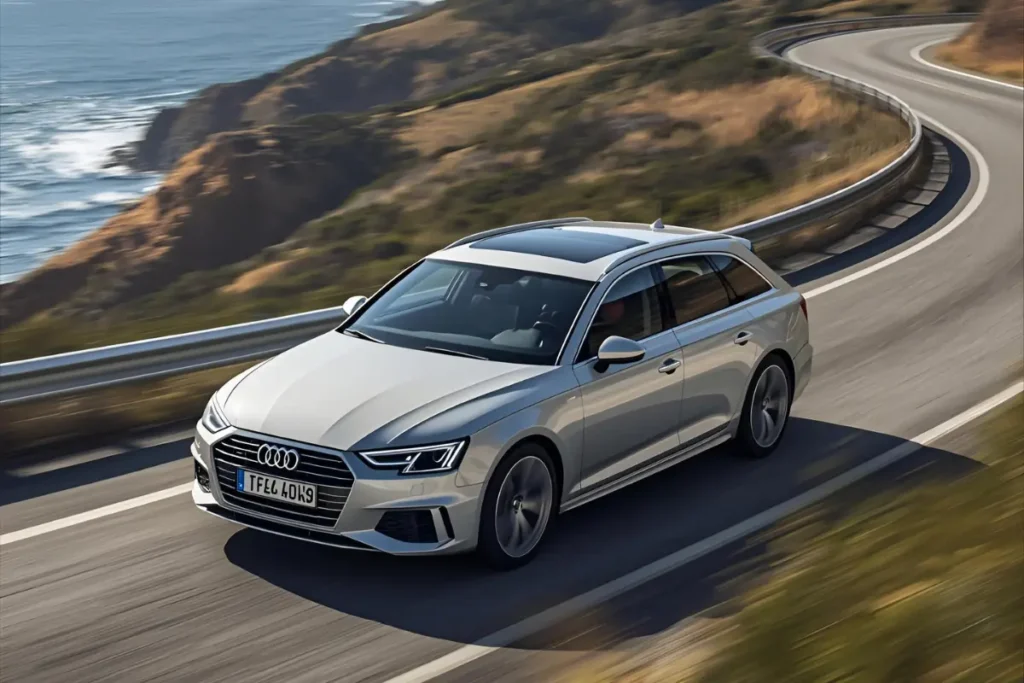
The 2021 Audi A4 Avant delivers a refined and touring-focused cabin environment built around high-quality materials, ergonomic optimisation and advanced acoustic insulation. The elongated Avant body supports improved spatial efficiency, while upgraded climate management and sound-deadening layers enhance long-distance comfort. This section evaluates how Audi’s interior engineering choices contribute to daily usability and sustained touring refinement.
Driver-Focused Ergonomics and Cabin Geometry
The cabin features a lower, more natural driving position with optimised pedal alignment and a driver-centric dashboard layout. Why does the revised cabin geometry reduce fatigue during extended journeys? Key controls sit within a tighter reach envelope, reducing arm movement while improved sightlines and a balanced seating angle support better posture and long-range comfort.
Seating Structure, Cushion Density and Long-Distance Support
Audi enhances the seats with multi-density foam layers and stronger lateral bolstering to improve stability over long trips. What makes these seats particularly suitable for touring? The layered foam design distributes pressure more evenly across critical contact points, helping maintain spinal alignment and reducing fatigue on long motorway segments.
Noise Isolation, Cabin Acoustics and NVH Mitigation
Acoustic glass, reinforced door seals and expanded insulation panels significantly reduce wind and tyre noise. How does this improve perceived cabin quality during highway use? Lower mid-frequency resonance limits auditory fatigue, creating a calmer environment that allows easier conversation and a more premium long-distance experience.
Comfort-Oriented Interior Features
- Multi-zone climate system with predictive thermal control
- Enhanced acoustic windshield technology
- Adjustable lumbar support with broader range
- Optimised ambient lighting distribution
Climate Control Performance and Environmental Comfort
The climate system uses multi-sensor feedback to maintain consistent temperature and humidity levels. Why does the system feel more stable compared with earlier generations? Adaptive airflow logic adjusts vent distribution and blower intensity before temperature deviations become noticeable, resulting in smoother thermal transitions and higher comfort consistency.
Safety and Driver Assistance Systems in the 2021 Audi A4 Avant
The 2021 Audi A4 Avant integrates a more advanced safety architecture built on improved sensor resolution, faster data fusion and enhanced predictive algorithms. The vehicle’s updated MLB electronics platform increases processing bandwidth, enabling quicker interpretation of road scenarios and earlier intervention when necessary. This section evaluates the hardware, system logic and real-world performance of the A4 Avant’s active and passive safety technologies.
Sensor Suite Architecture and Hardware Processing Power
Audi upgrades the radar, front camera and ultrasonic array to capture a wider field of view with greater accuracy. Why does the newer processor deliver noticeably quicker intervention? The enhanced computing unit accelerates object classification, enabling the assistance systems to anticipate hazards earlier and engage corrective measures with less delay.
Assistance System Hardware Overview
| Component | Function | Technical Improvement |
|---|---|---|
| Front Radar | ACC, distance management | Wider angle, longer range |
| Front Camera | Lane tracking, traffic sign detection | Higher-resolution optics |
| Ultrasonic Sensors | Low-speed proximity detection | Improved noise filtering |
| Control Unit | Data fusion | Faster processing cycles |
Adaptive Cruise Control Behaviour and Lane Guidance Quality
Adaptive cruise control now applies smoother throttle modulation and more progressive braking. Why does lane guidance feel more natural in the 2021 model? Reduced steering intervention force prevents abrupt corrections, creating a more organic lane-centering experience, particularly during long highway journeys.
Collision Mitigation, Emergency Braking and Threat Prediction
The collision-avoidance system cross-references radar and camera data to identify risks with greater reliability. What enables earlier braking intervention in sudden hazards? Improved trajectory prediction algorithms allow the system to detect closing speeds sooner, applying brake pressure before the driver perceives the full threat.
Low-Speed Manoeuvring and Parking Assistance Logic
Enhanced ultrasonic coverage supports more accurate proximity detection in tight environments. Why does the system feel more reliable in confined parking structures? The refined filtering logic reduces false positives caused by reflective surfaces, producing clearer distance feedback for the driver.
Structural Crash Protection and Impact Energy Management
Strengthened load paths, reinforced side-impact zones and an optimised subframe design enhance passive safety. How do these structural upgrades influence crash survivability? Energy is channelled through predefined deformation routes, reducing cabin intrusion and maintaining passenger-cell integrity during severe impacts.
Technology, Infotainment and Digital Systems of the 2021 Audi A4 Avant
The 2021 Audi A4 Avant adopts Audi’s latest digital architecture, offering faster interface response, improved graphics quality and expanded connectivity options. The upgraded MMI Touch system incorporates a more powerful processor and streamlined navigation logic, while the enhanced Virtual Cockpit delivers clearer data presentation. This section breaks down how these systems behave in real-world usage and how they enhance everyday driving.
MMI Touch Interface Responsiveness and UI Flow
Audi’s updated MMI Touch interface benefits from reduced latency, improved touch sensitivity and cleaner menu transitions. Why does the system feel significantly quicker during rapid switching between functions? The upgraded processor shortens communication paths between software modules, enabling faster screen changes and smoother animations during multitasking.
Virtual Cockpit Display Logic and Graphic Fidelity
The Virtual Cockpit receives higher frame rates and revised anti-aliasing profiles to enhance clarity at speed. How does this improvement affect long-distance usability? Sharper visuals reduce eye strain during sustained motorway driving, making navigation cues and driver-assistance alerts easier to interpret in dynamic conditions.
Connectivity Functions, Smartphone Integration and eSIM Services
The A4 Avant includes Apple CarPlay, Android Auto, cloud-assisted navigation and an embedded eSIM enabling real-time services. What makes route updates and traffic predictions more reliable in this generation? Enhanced antenna architecture and improved data prioritisation reduce latency, allowing more accurate and timely route recalculations.
Digital Function Highlights
- Cloud-based navigation with faster recalculation
- Full smartphone integration
- Enhanced voice recognition via natural-language processing
- Audi Connect remote service support
- Higher bandwidth for simultaneous tasks
Audio System Engineering, DSP Logic and Sound Reproduction
Audi refines the audio signal path and improves speaker housing rigidity to create cleaner sound reproduction. Why does the system deliver clearer mid and high frequencies at elevated volumes? Reduced panel resonance and more precise DSP correction minimise distortion, maintaining clarity even during dynamic music playback.
Over-the-Air Update Capability and Module Partitioning
The electronic framework supports selective OTA updates for infotainment and select driver-assistance modules. How does module partitioning improve update reliability? Critical systems are isolated from non-essential software layers, ensuring updates occur without interrupting core vehicle functions.
Fuel Efficiency and Real-World Economy of the 2021 Audi A4 Avant
The 2021 Audi A4 Avant delivers improved efficiency through optimised TFSI combustion, aerodynamic refinement and a strategically calibrated 12-volt mild-hybrid system. The updated MLB platform reduces mechanical drag, while revised boost logic and recuperation cycles support consistent consumption in mixed driving. This section examines how these engineering measures translate into measurable real-world economy in both urban and long-distance touring conditions.
Fuel Consumption Comparison Across A4 Avant Engine Variants
| Engine | Urban Use | Highway Use | Combined Efficiency | Technical Notes |
|---|---|---|---|---|
| 2.0 TFSI 35 | Moderate | High | High | Efficient boost curve and low friction design |
| 2.0 TFSI 40 | Moderate | Very High | High | Strong mid-RPM torque supports taller gearing |
| 2.0 TFSI 45 | Higher | High | Moderate–High | Performance mapping with MHEV support |
TFSI Consumption Characteristics in Urban and Touring Use
The latest TFSI engines balance responsive turbo behaviour with measured fuel delivery, allowing efficient progress in varied traffic conditions. Why does the 2.0 TFSI 40 often achieve better touring economy compared with its power output? Its broad mid-range torque reduces the need for downshifts, maintaining low RPM operation during gentle gradients and steady cruising.
Mild-Hybrid Recuperation Efficiency and Coasting Function
The 12-volt MHEV system recovers kinetic energy during deceleration and powers auxiliary systems independently during coasting. How does this recuperation translate into tangible fuel savings? Reduced alternator drag and extended engine-off phases lower load on the combustion engine, improving overall efficiency in stop-and-go scenarios and low-load highway segments.
Aerodynamic Influence on Long-Distance Fuel Economy
Refined front bumper channels, smoother underbody panels and a subtle roof spoiler contribute to reduced aerodynamic drag. How does improved airflow management influence real-world consumption? Lower drag coefficient values require less engine power to sustain cruising speeds, resulting in noticeable savings during long journeys at constant velocities.
Dimensions, Cargo Capacity and Practicality of the 2021 Audi A4 Avant
The 2021 Audi A4 Avant maximises the inherent advantages of the wagon body style with a well-packaged cabin, expanded loading flexibility and refined ergonomic improvements. The MLB platform’s efficient layout supports generous passenger space, while the elongated roofline enables a more usable cargo bay than the sedan variant. This section explores how interior geometry, trunk design and daily-use features contribute to the Avant’s strong practicality profile.
Passenger Space, Seating Geometry and Cabin Packaging
The cabin benefits from a balanced seating position, optimised pedal alignment and increased shoulder width. Why does the A4 Avant feel more spacious than its sedan counterpart? Reduced dashboard depth and thinner front seat backrests free additional knee, foot and shoulder room, improving overall cabin openness without altering exterior proportions.
Practicality-Oriented Advantages
- Wide-opening rear doors
- Deep door-bin and console storage
- Low, flat loading floor
- Split-folding rear seats with extended load-through capability
Cargo Bay Volume, Floor Design and Load Flexibility
The extended roofline and rectangular trunk aperture enhance cargo usability. What makes the load area particularly functional for mixed luggage types? The flat loading floor, low sill height and uniform side panels allow bulky items to be placed easily while accommodating long objects with the folded seatbacks.
Daily Usability, Entry/Exit Comfort and Cabin Accessibility
Optimised door hinge geometry and revised sill height improve daily usability. How does hinge design influence comfort in narrow parking spots? A wider operating angle requires less lateral clearance, enabling occupants to enter and exit the cabin more comfortably in confined urban areas.
Urban Maneuverability, Turning Radius and Exterior Proportions
Compact overhangs and precise steering calibration support easy manoeuvring in tight city environments. Why does the A4 Avant feel smaller than its actual footprint? The slim A-pillars improve forward visibility, while a tight turning radius helps drivers confidently position the vehicle in dense traffic or parking situations.
Common Issues, Reliability Trends and Technical Notes on the 2021 Audi A4 Avant
The 2021 Audi A4 Avant demonstrates strong long-term durability due to its mature MLB platform, robust TFSI engines and improved electronic architecture. While the model generally performs reliably, certain patterns appear in electronics, intake systems and weather-dependent sensor behaviour. This section provides a technical overview of these observations to help owners understand real-world reliability trends.
Electronics Behaviour, Sensor Stability and Software Variability
The A4 Avant may occasionally exhibit minor infotainment slowdowns or brief driver-assistance variability. Why do these inconsistencies occur more frequently in dense urban environments? High electromagnetic interference and complex traffic scenarios increase sensor workload, which can cause temporary slowdowns until system recalibration restores normal performance.
Powertrain Durability, Wear Patterns and Long-Term Health
The TFSI engines are mechanically strong but can develop carbon accumulation on intake valves over extended low-temperature, stop-start driving. How does repeated short-trip usage accelerate this process? Reduced exhaust temperature prevents natural carbon burn-off, allowing deposits to form more quickly and mildly restricting airflow over time.
Common Technical Issue Overview
| Category | Observable Symptoms | Likely Technical Cause |
|---|---|---|
| Sensors | False proximity alerts, brief lane-read interruptions | Environmental interference or calibration drift |
| Intake System | Rough idle, reduced throttle response | Carbon buildup on intake valves |
| Infotainment | Occasional UI lag or slow boot | Data fragmentation, outdated module firmware |
| Suspension | Light knocking over sharp bumps | Bushing material ageing |
Interior Fit-and-Finish Deviations and Material Behaviour
Minor interior noises may arise from door panels or dashboard elements on rough surfaces. What causes these intermittent rattles despite strong build quality? Differing thermal expansion rates between materials create micro-movement at panel interfaces, producing light noise under specific temperature or vibration conditions.
Sensor Sensitivity in Adverse Weather and Environmental Factors
Snow, heavy rain and reflective surfaces can temporarily affect ultrasonic and camera-based systems. Why does inclement weather reduce assistance accuracy? Water droplets distort ultrasonic pulses and reduce camera contrast, prompting the system to adopt conservative detection thresholds until visibility and surface clarity improve.
Maintenance Requirements and Ownership Experience of the 2021 Audi A4 Avant
The 2021 Audi A4 Avant benefits from predictable maintenance intervals, widely available MLB platform components and well-engineered access points that simplify routine servicing. Improved material durability, enhanced thermal management and stable electronic architecture support consistent long-term ownership. This section outlines the primary maintenance needs, typical wear characteristics and practical considerations for sustaining optimal performance.
Scheduled Service Items, Intervals and Required Checks
The A4 Avant follows a structured maintenance schedule that includes lubrication service, filtration replacements, system diagnostics and periodic software updates. Why does modern Audi maintenance place significant emphasis on software checks? Critical vehicle systems are integrated through interconnected modules, meaning updated firmware is essential to preserve engine mapping accuracy, assistance-system functionality and climate control stability.
Primary Maintenance Tasks
- Engine oil and filter replacement
- Air and cabin filter renewal
- Brake fluid and wear inspection
- Transmission fluid checks depending on use
- Control-module software updates
- Coolant and auxiliary-system diagnostics
Consumable Wear Characteristics and Longevity Expectations
Tyres, brake pads and suspension bushings exhibit predictable wear when serviced regularly. What driving habit has the greatest influence on brake life in TFSI-equipped models? Repeated hard deceleration generates heat saturation in the pads and discs, accelerating wear, whereas smoother braking during highway travel significantly extends component longevity.
Parts Availability, Platform Serviceability and Repair Access
The shared MLB architecture ensures strong parts availability and efficient workshop processes. How does platform commonality improve serviceability? Standardised component placement enables technicians to reach critical areas more easily, reducing labour time and ensuring sustained parts support across regions.
Long-Term Operating Behaviour and Ownership Insights
Owners typically report stable long-term performance, strong refinement and minimal unexpected maintenance requirements. What supports the A4 Avant’s dependable long-distance behaviour? High-quality engine materials, reinforced chassis mounting points and a well-sealed body structure help maintain efficiency, comfort and driving precision even at elevated mileage.
Frequently Asked Questions About 2021 Audi A4 Avant
Is the 2021 Audi A4 Avant a reliable long-term vehicle?
The 2021 A4 Avant is generally dependable due to its mature MLB platform, proven TFSI engines and refined software architecture. Most long-term issues tend to be minor, relating to sensor calibration or infotainment modules, and are often resolved through routine updates. Structural rigidity and high material quality further enhance long-term durability.
How comfortable is the A4 Avant for long-distance touring?
The Avant excels in long journeys thanks to its multi-density seat cushioning, low cabin noise levels and stable suspension tuning. Enhanced climate control logic and improved seat ergonomics reduce fatigue over extended periods, making it an ideal companion for motorway travel or mixed touring conditions.
Does the A4 Avant offer good fuel economy in real-world use?
Yes. The combination of refined TFSI combustion, mild-hybrid recuperation and aerodynamic improvements ensures efficient operation in both city and highway driving. Models like the 2.0 TFSI 40 achieve particularly balanced consumption due to robust mid-range torque that supports low-RPM cruising.
What technology features stand out in the 2021 A4 Avant?
Key highlights include the responsive MMI Touch, high-clarity Virtual Cockpit, cloud-enhanced navigation and improved audio signal processing. Faster processor architecture reduces interface lag, while enhanced connectivity strengthens real-time route data and smartphone integration.
Are there common issues owners should be aware of?
Some owners report minor infotainment lag, occasional sensor sensitivity in adverse weather and small cabin noises on rough terrain. These issues are typically non-mechanical and are often resolved through software updates, recalibration or simple component adjustments.
How does quattro improve all-weather capability?
quattro-equipped variants use predictive torque distribution to improve grip before wheel slip occurs. By analysing steering angle, wheel speed and throttle input, the system ensures strong stability in wet, icy or uneven conditions, offering a secure driving experience year-round.
What maintenance steps help prolong engine life?
Regular oil changes, adherence to warm-up periods and avoidance of short-trip driving are key to maintaining engine health. TFSI engines also benefit from occasional high-temperature runs that help burn off carbon deposits and keep intake airflow unobstructed.
Is the A4 Avant practical for family use?
Yes. The Avant provides ample passenger space, a versatile cargo layout and wide-opening doors for easy access. With ISOFIX mountings, a low loading floor and split-folding rear seats, it suits families who require both premium comfort and everyday usability.